The Miru 2026 Roadmap: What We're Building Next
Recurring invoices, multi-currency, a mobile app, and webhooks. Here's what's coming to Miru in 2026 and why we're building it in this order.
 Vipul A M · · 3 min read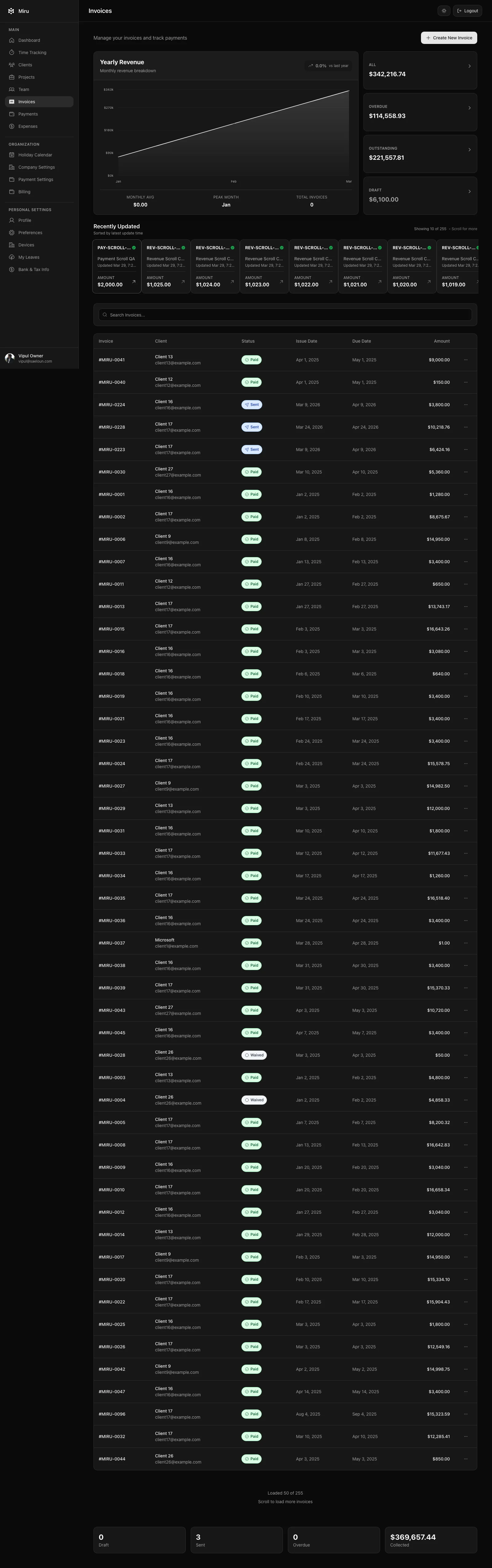
The Four Things We’re Building Right Now
Recurring invoices. This is the most-requested feature from agencies and consultancies. You have a client on a monthly retainer. Every month, you create the same invoice manually, fill in the same line items, click send. It’s tedious and it’s the kind of work computers were invented to eliminate.
Recurring invoices in Miru will let you set a schedule — weekly, monthly, quarterly — and Miru will auto-generate and send the invoice. You set it up once. It runs forever until you tell it to stop. No manual intervention. No forgetting to invoice a client because you were busy.
Multi-currency support. If you’re a US agency with European clients, you’re currently doing currency conversion in your head or in a spreadsheet. That’s broken. Miru will support native multi-currency billing — create an invoice in EUR, display it to the client in EUR, and track the USD equivalent on your side. Not just Stripe conversion at payment time. Real multi-currency from the invoice creation step.
Mobile app for iOS and Android. We know. This is overdue. The CLI is great for developers, but most people tracking time need a phone app. We’re building native apps — not a web view wrapped in Capacitor — that do time tracking, expense logging, and invoice viewing. The things you actually do on a phone. Not the admin stuff that belongs on a desktop.
Webhooks. If you’re building integrations with Miru’s API, you’re currently polling for changes. That’s wasteful and slow. Webhooks will push real-time event notifications to your endpoints. Invoice paid. Time entry created. Expense approved. You register a URL, we call it when things happen. Simple as it should be.
What’s Planned After That
Calendar integration with Google and Outlook. Bulk time import via CSV for teams migrating from Harvest or Toggl. Custom invoice templates for people who care about how their invoices look. Project budgets with alerts so you don’t accidentally burn through a fixed-bid project. Tax calculation for sales tax and VAT. Team capacity planning to see who’s available before you assign work.
That’s the full list. Six items. Not sixty.
Why This Order
We prioritize based on two things: how many people are asking for it, and how much pain the lack of it causes daily.
Recurring invoices and multi-currency are the top two by a wide margin. They affect how people get paid. That’s not a nice-to-have — it’s blocking revenue for some teams. Mobile is third because the CLI solved the problem for developers but not for everyone else. Webhooks are fourth because they unblock the integration ecosystem.
We don’t do annual planning. We don’t commit to dates six months out. We ship features when they’re ready, not when a Gantt chart says they should be ready. If recurring invoices ship in April, great. If they ship in May because we found an edge case with prorated billing, that’s fine too.
The roadmap is public. The code is on GitHub. If you want to influence what gets built, open an issue. The features that get the most real-world use cases tend to move up the list.
We’re not building a feature factory. We’re building the tool we use every day to run our own business. That keeps us honest.
See the full public roadmap or start using Miru today.
Missed the 3.0 launch? Read the announcement →
Hard Stop
Use it in production and tell us exactly where the workflow still fights you.
Start with Miru or read the docs.
Vipul A M
Co-founder at Saeloun. Building Miru. Rails contributor. Shipping from Pune, India.
Read next
Pricing update: $1 per member, from the first member
Miru's cloud pricing is changing. No more free tier — every member is $1/month from day one. Self-hosting stays free. Here's the reasoning.
How We Use gbrain to Build Miru
How Saeloun uses gbrain, gstack, Codex, Claude, MCP, and repo signals to build Miru with memory, safer AI automation, and proof before claims.
Miru Desktop: Local-first Timer for Mac, Linux, and Windows
Miru Time Tracking is available as a local-first desktop timer with menu bar controls, timer stack, idle recovery, time entries, and Miru web sync.
Put it to work
Run one cleaner billing cycle in Miru.
If this article is about tracking time, billing clients, comparing tools, or automating work, Miru is the product version of that idea. Start for $1/member, invite the team, and send the next invoice from tracked work.
What you get
- Time tracking, invoices, expenses, and payments in one place.
- $1 per member per month. Free if you self-host.
- Open source, with CLI, API, MCP, and self-hosting paths.
The article is the argument. Miru is the workflow.
Track the work, approve the hours, send the invoice, and get paid without bolting together three separate tools.