Open Source Time Tracking:
Own Your Data, Own Your Tools
Most time tracking software is a black box. You put your data in, you pay every month, and you hope the company doesn't get acquihired or jack up prices. Miru is MIT licensed and open source. Self-host it, read the code, or use our cloud. Your call.
Self-host free forever, or use the cloud at $1/member/month. Same product either way.
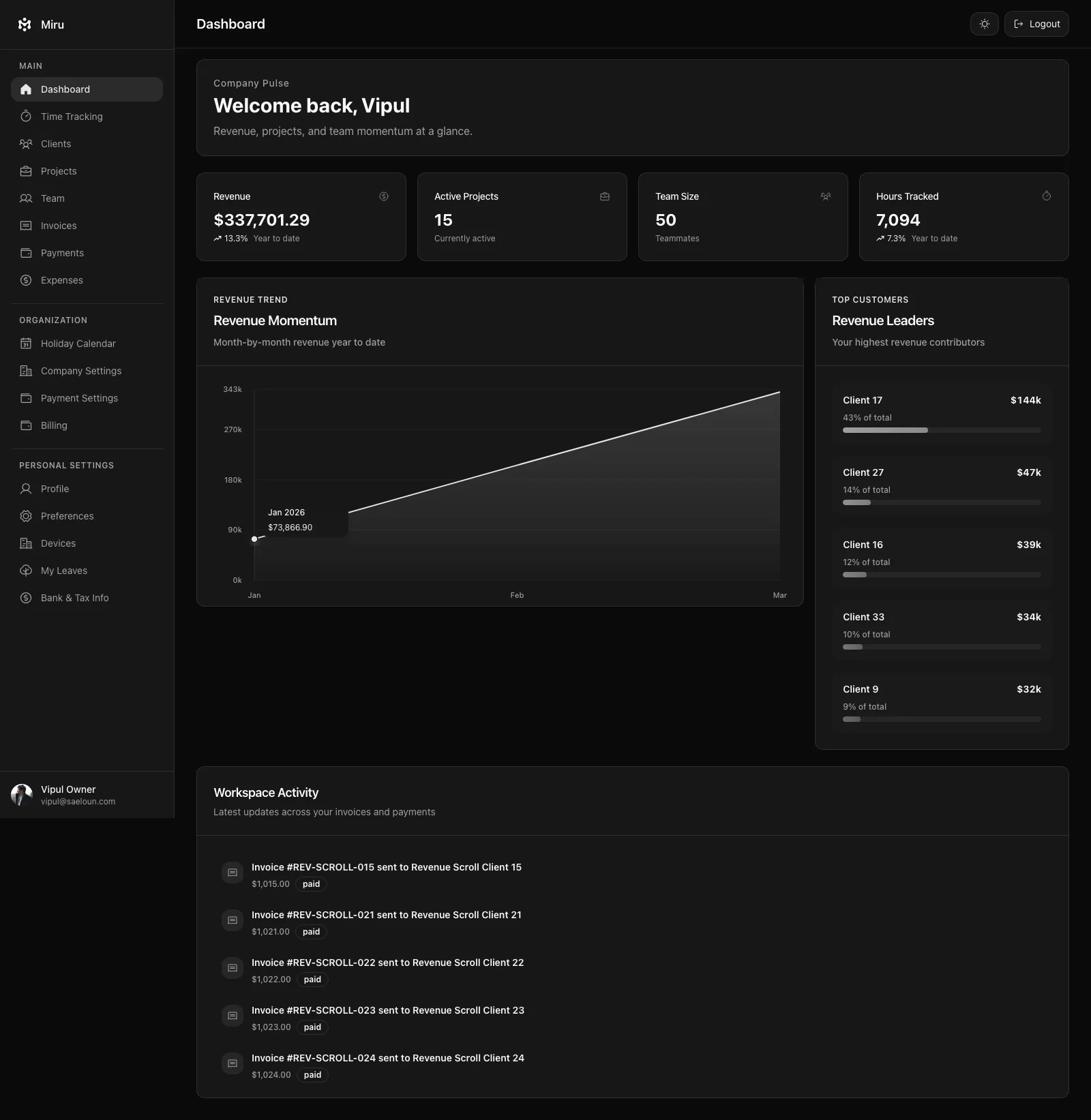
Why open source matters for time tracking
Your time data is your business data. You should own it — not rent access to it.
No vendor lock-in
MIT licensed. The code is yours. If we disappeared tomorrow — which we won't — you'd still have a working time tracker. Export your data, fork the repo, or switch providers. Your choice, always.
Self-host on your servers
Run Miru on a $20/month VPS and serve your entire company. Your data never leaves your infrastructure. No third-party analytics. No telemetry. Compliance teams love this.
Community-driven development
Features get built because users need them, not because a product manager is chasing a KPI. File an issue, submit a PR, vote on the roadmap. This is how software should be built.
Open source time trackers compared
Miru vs Kimai vs the proprietary tools that call themselves "free."
| Feature | Miru | Kimai | TimeCamp | Clockify |
|---|---|---|---|---|
| License | MIT (fully open) | AGPL-3.0 | Proprietary | Proprietary |
| Self-hostable | Yes | Yes | No | No |
| Invoicing built in | Yes | Plugin (paid) | No | No |
| Expense tracking | Yes | Plugin (paid) | Limited | No |
| CLI | Yes | No | No | No |
| REST API | Full API | Yes | Yes | Yes |
| Stripe payments | Yes | No | No | No |
| Tech stack | Rails 8 + React 18 | Symfony (PHP) | N/A | N/A |
| Cloud option | $1/member/mo | From €9/mo | From $3.99/user/mo | From $3.99/user/mo |
Get started in three steps
Cloud or self-hosted. Either way, you're tracking time within the hour.
Sign up or self-host
Create an account at app.miru.so — 30 seconds, $1/member/month. Or clone the repo from GitHub and deploy on your own infrastructure. Docker Compose included.
Add your projects and team
Create clients, add projects, invite team members. Five roles — owner, admin, employee, book keeper, client. Assign people to projects and set hourly rates.
Start tracking
Timer, manual entry, weekly timesheet, or CLI. Pick whatever fits your workflow. Time entries become invoices. Invoices become payments. That's the whole loop.
Questions about open source time tracking
Is Miru truly open source?
What's the difference between MIT and AGPL for time tracking?
Can I self-host Miru for my company?
How does Miru compare to Kimai?
How much does the Miru cloud cost?
Your tools should be as open as your source code.
Cloud at $1/member/month. Self-host for $0 forever. MIT licensed.