Why We Charge $1 Per Person (And Why Everyone Else Charges 10x More)
Per-seat pricing at $10-15/person is a racket. Here's the math behind Miru's $1/member pricing and why it works.
 Vipul A M · · 4 min read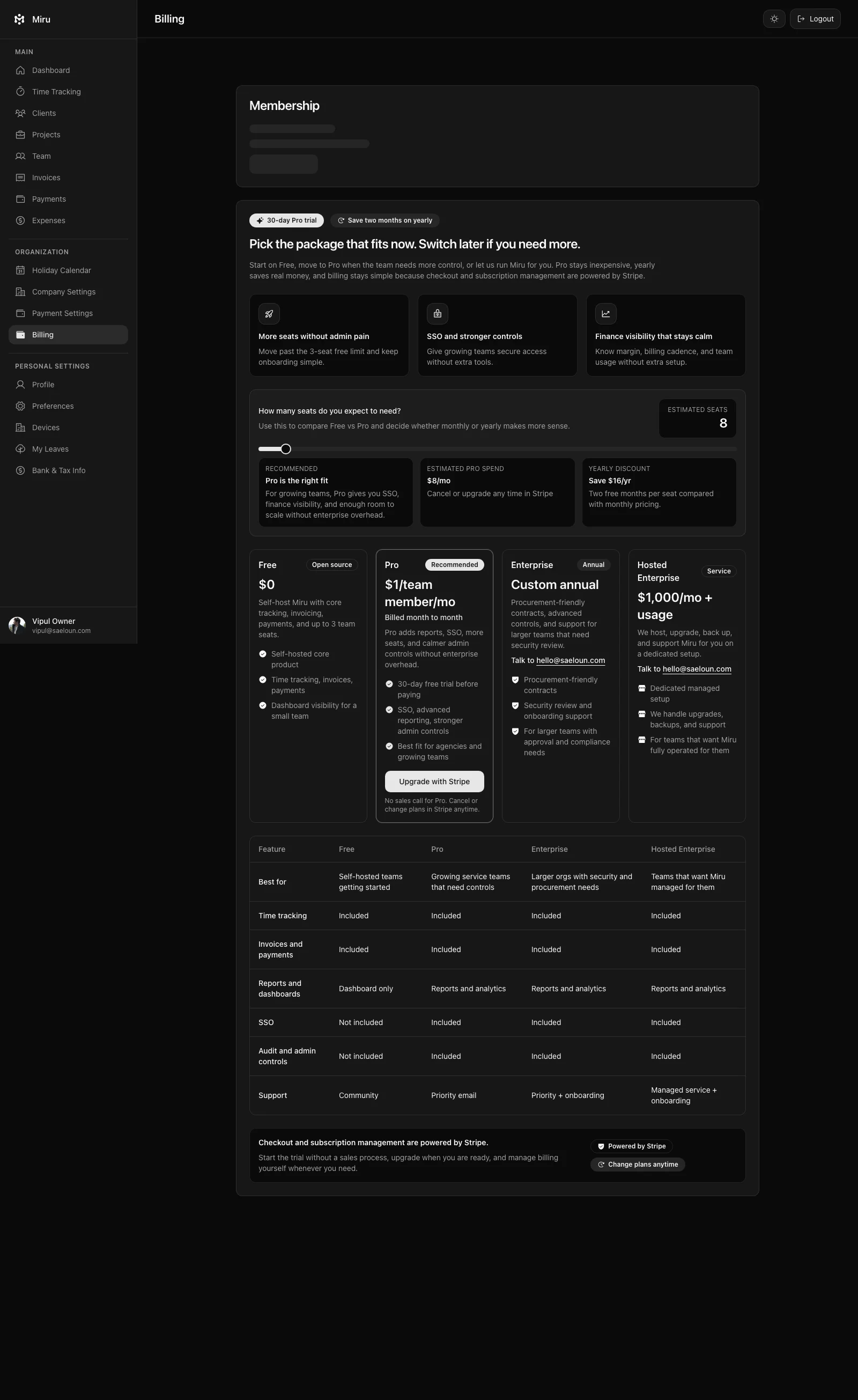
The VC Pricing Trap
Most SaaS companies raise venture capital. The moment you take VC money, you’re on a growth treadmill. Your investors expect 3x revenue growth year over year. The easiest way to hit that number isn’t to get more customers — it’s to charge each customer more.
So prices go up. $8/seat becomes $10/seat becomes $12/seat. New features get locked behind a “Business” tier. Then an “Enterprise” tier appears with SSO and audit logs — features that cost almost nothing to build but command a 3x price premium because enterprises will pay it.
The product doesn’t get 3x better. The price does. And you’re trapped because migrating your team’s time data to a new tool is a nightmare nobody wants to deal with. They know this. That’s the model.
We didn’t take VC money. We don’t have investors telling us to maximize revenue per seat. We have customers telling us what to build and a consulting business that pays the bills while we build it.
How $1/Person Works
People hear “$1 per person” and assume we’re either losing money or about to raise prices. Neither.
Here’s the cost structure:
We’re based in India. Our engineering team is in Pune. The cost of living and the cost of talent are dramatically lower than San Francisco or New York. A senior Rails developer in Pune costs roughly a quarter of what they’d cost in the Bay Area. This isn’t outsourcing. This is our team, building our product, in our city. The math just works differently.
We’re open source. The community contributes code. Bug reports come in from users who read the source and pinpoint the exact line that’s broken. Documentation improvements arrive as pull requests. We don’t have a 50-person engineering team because we don’t need one. The open-source community extends our team without extending our payroll.
We have zero sales team. No SDRs. No AEs. No demo calls. No “let’s schedule a follow-up.” You sign up, you use the product, you upgrade if you want. The product is the sales pitch. This alone eliminates the biggest line item on most SaaS companies’ P&L.
We have near-zero marketing spend. Word of mouth. Open source visibility. Blog posts like this one. SEO. That’s the marketing budget.
Infrastructure costs are minimal. Rails 8 with Solid Queue and Solid Cache means we run on PostgreSQL and application servers. No Redis cluster. No Elasticsearch. No managed Kubernetes. The hosting bill for serving thousands of teams is surprisingly small.
Stack all of that up and $1/person is a healthy margin. Not a loss leader. Not a bait-and-switch. A real price that works for a company built the way we’re built.
The Math for Your Team
Let’s make it concrete.
| Team Size | Harvest | Toggl Business | Monday.com | Miru |
|---|---|---|---|---|
| 10 people | $1,296/yr | $2,400/yr | $3,600/yr | $120/yr |
| 25 people | $3,240/yr | $6,000/yr | $9,000/yr | $300/yr |
| 50 people | $6,480/yr | $12,000/yr | $18,000/yr | $600/yr |
| 100 people | $12,960/yr | $24,000/yr | $36,000/yr | $1,200/yr |
At 100 people, the difference between Miru and Toggl is $22,800 per year. That’s a developer’s salary in many markets. You’re paying for a time tracker or you’re paying for a person who builds things. Your call.
But Is the Product Actually Good?
Fair question. Cheap and bad is worse than expensive and good.
Miru isn’t cheap and bad. It’s cheap and built-by-people-who-use-it-every-day. We run a consulting company. We track time in Miru. We send invoices through Miru. We manage expenses in Miru. When something is annoying, we feel the pain before any customer reports it.
The codebase is open source. Read it. Run it locally. Compare the feature set. We have time tracking, invoicing, expense management, team management, leave management, client portals, Stripe payments, six report types, a CLI, and a full API. All included. No tier gating.
The Price Won’t Change
I’ll say it plainly: we’re not going to raise the price to $5/person next year. We’re not going to introduce an enterprise tier at $15/person. We’re not going to lock features behind a paywall.
We’d rather have 10,000 happy customers at $1 than 100 trapped ones at $50.
That’s not a tagline. It’s the business model.
See the full pricing comparison to understand the math.
Try Miru free at app.miru.so. Or self-host it for $0 forever from GitHub.
Hard Stop
If you agree, build this way. If you disagree, test the opposite and measure the real cost.
Start with Miru or read the docs.
Vipul A M
Co-founder at Saeloun. Building Miru. Rails contributor. Shipping from Pune, India.
Read next
You're Paying 10x Too Much for Time Tracking
A 50-person team on Harvest pays $600/month. On Miru Pro, that's $50. Here's the math on why per-seat pricing is a scam.
Per-Seat Pricing Is Broken: A Rant
Slack, Harvest, Jira — they all charge per seat. Here's why this pricing model punishes growth and how to escape it.
Why We Don't Do Annual Contracts
No annual lock-ins. No discounts for commitment. If the product is good, people stay. If it's not, no contract will save you.
Put it to work
Run one cleaner billing cycle in Miru.
If this article is about tracking time, billing clients, comparing tools, or automating work, Miru is the product version of that idea. Start for $1/member, invite the team, and send the next invoice from tracked work.
What you get
- Time tracking, invoices, expenses, and payments in one place.
- $1 per member per month. Free if you self-host.
- Open source, with CLI, API, MCP, and self-hosting paths.
The article is the argument. Miru is the workflow.
Track the work, approve the hours, send the invoice, and get paid without bolting together three separate tools.