You're Paying 10x Too Much for Time Tracking
A 50-person team on Harvest pays $600/month. On Miru Pro, that's $50. Here's the math on why per-seat pricing is a scam.
 Vipul A M · · 2 min read
The real cost of per-seat time tracking
| Team Size | Harvest ($10.80/seat) | Toggl Track ($9/seat) | FreshBooks (Lite $17) | Miru Pro ($1/member) |
|---|---|---|---|---|
| 10 users | $108/mo ($1,296/yr) | $90/mo ($1,080/yr) | $17/mo ($204/yr)* | $10/mo ($120/yr) |
| 25 users | $270/mo ($3,240/yr) | $225/mo ($2,700/yr) | N/A** | $25/mo ($300/yr) |
| 50 users | $540/mo ($6,480/yr) | $450/mo ($5,400/yr) | N/A** | $50/mo ($600/yr) |
| 100 users | $1,080/mo ($12,960/yr) | $900/mo ($10,800/yr) | N/A** | $100/mo ($1,200/yr) |
FreshBooks Lite includes only limited time tracking and caps at a low client count. *FreshBooks doesn’t scale to large teams without jumping to premium plans that cost significantly more.
Look at the 50-user row. Harvest: $540/month. Miru: $50/month. That’s not a 10% savings. That’s a 90% reduction. For the same core functionality — tracking time, sending invoices, running reports.
At 100 users, you’re paying Harvest nearly $13,000 a year. Miru Pro is $1,200. You could buy your entire team lunch every month with the difference and still come out ahead.
“But they have more features”
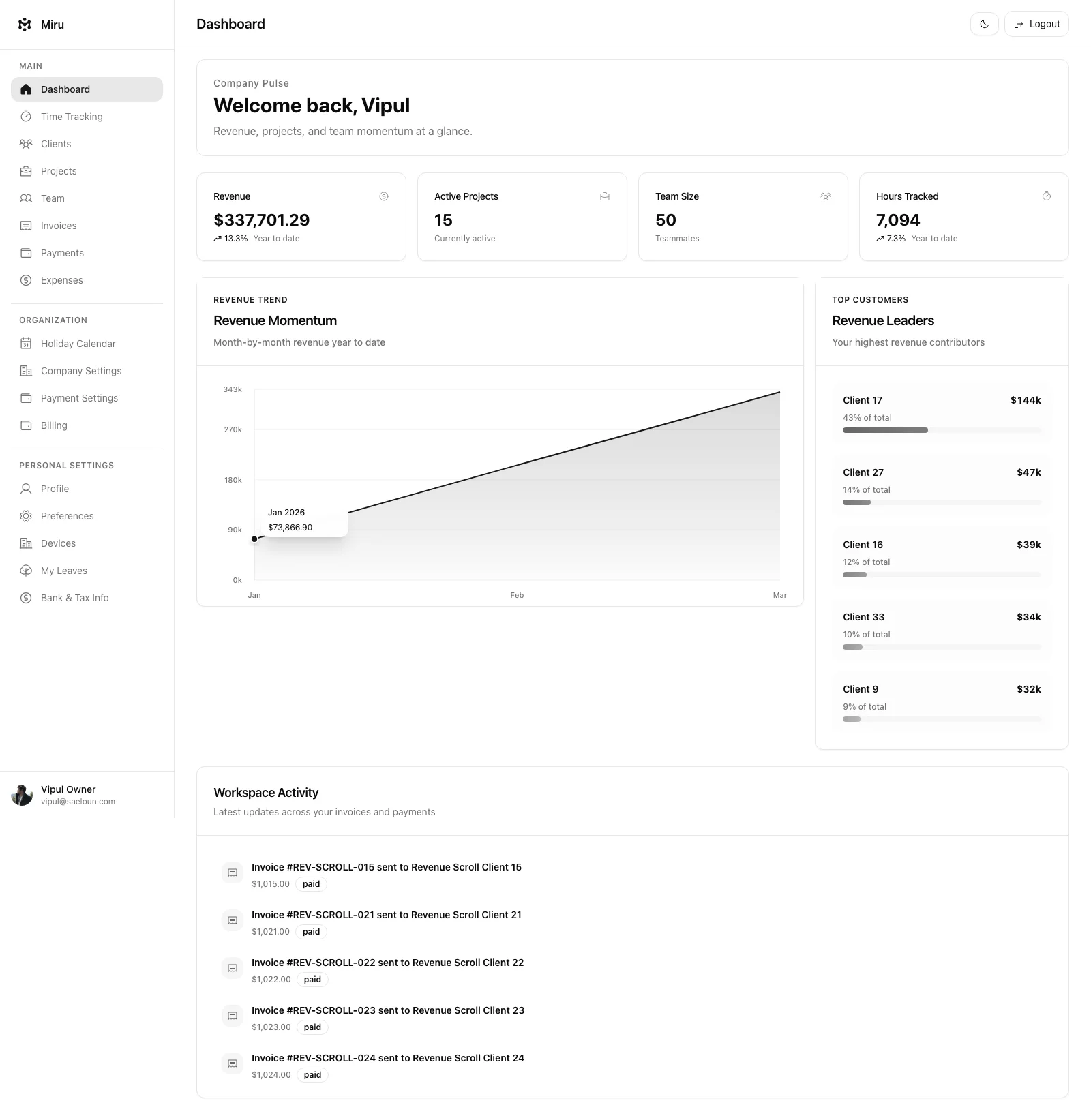
Do they? Miru ships with six report types, five team roles, leave management, expense tracking, Stripe integration, a full REST API, and a CLI for terminal-based workflows. Harvest doesn’t have a CLI. Toggl doesn’t do invoicing. FreshBooks doesn’t do leave management.
The “features justify the price” argument falls apart when the cheaper product has more features. What you’re actually paying for with per-seat pricing is a business model, not a product.
The self-hosted nuclear option
But here’s where it gets really interesting. Miru is open source under the MIT license. You can self-host it on your own infrastructure. At that point, the cost per user drops to zero. A $20/month VPS runs Miru for a 200-person team.
Let’s add that to the math:
- 200 users on Harvest: $2,160/month ($25,920/year)
- 200 users on Miru (self-hosted): ~$20/month ($240/year)
That’s a 99% reduction. Your time tracking costs less than a single Harvest seat.
The uncomfortable truth
Per-seat pricing exists because companies can get away with it. You sign up when you’re small and the $9/user feels reasonable. Then you grow. By the time you’re 50 people, you’ve got years of time data locked in their system, and migrating feels like more hassle than just paying. That’s the trap.
Miru charges $1/member because that’s what fair pricing looks like for a time tracking tool. And if even that feels like too much, the self-hosted option is right there on GitHub.
Stop overpaying. Start free with Miru and keep the difference.
Hard Stop
Run this loop for two weeks without skipping cleanup. The compounding effect is real.
Start with Miru or read the docs.
Vipul A M
Co-founder at Saeloun. Building Miru. Rails contributor. Shipping from Pune, India.
Read next
Why We Charge $1 Per Person (And Why Everyone Else Charges 10x More)
Per-seat pricing at $10-15/person is a racket. Here's the math behind Miru's $1/member pricing and why it works.
Per-Seat Pricing Is Broken: A Rant
Slack, Harvest, Jira — they all charge per seat. Here's why this pricing model punishes growth and how to escape it.
Why We Don't Do Annual Contracts
No annual lock-ins. No discounts for commitment. If the product is good, people stay. If it's not, no contract will save you.
Put it to work
Run one cleaner billing cycle in Miru.
If this article is about tracking time, billing clients, comparing tools, or automating work, Miru is the product version of that idea. Start for $1/member, invite the team, and send the next invoice from tracked work.
What you get
- Time tracking, invoices, expenses, and payments in one place.
- $1 per member per month. Free if you self-host.
- Open source, with CLI, API, MCP, and self-hosting paths.
The article is the argument. Miru is the workflow.
Track the work, approve the hours, send the invoice, and get paid without bolting together three separate tools.