The Tools We Actually Use to Build Miru
No sponsored content. No affiliate links. Just the actual tools our 15-person team uses daily and why.
Every “tools we use” blog post has a disclaimer at the bottom about affiliate links. This one doesn’t, because there are no affiliate links. No one paid us to mention them. No one even knows we’re writing this. These are the actual tools our 15-person team uses to build and run Miru, with one honest sentence about why we picked each one.
Code
Editor: VS Code + Claude Code. Most of the team runs VS Code with Claude Code for AI-assisted development. A few developers use Cursor. Nobody uses Vim in production anymore, though two people will argue about this at lunch. Claude Code genuinely changed how fast we ship — not because it writes perfect code, but because it handles the tedious parts so we can focus on the interesting problems.
Language/Framework: Ruby on Rails 8 + React 18. Rails on the backend, React on the frontend. Rails gives us conventions, speed, and a single-person framework that punches way above its weight. React gives us the component model and ecosystem we need for a complex time-tracking UI. We’ve considered other frameworks exactly zero times.
Version Control: GitHub. This barely needs an explanation. We use GitHub for code, issues, pull requests, and project management. We tried Linear for issue tracking, liked it, but couldn’t justify the cost when GitHub Issues works fine for our size.
Infrastructure
Hosting: Render (app), Cloudflare Pages (marketing site). Render runs our Rails app, workers, and PostgreSQL database. It’s Heroku without the abandonment issues. Deploys take 90 seconds. Cloudflare Pages hosts this marketing site because it’s static and free.
Database: PostgreSQL on Render. Postgres does everything. Full-text search, JSON columns, proper transactions, and it’s been rock-solid for three years. We’ve never had a database-related outage. Not once.
CI: GitHub Actions. Our test suite runs in about 4 minutes. We’ve got a simple workflow: run tests, check linting, deploy if green. Nothing fancy. Fancy CI pipelines are a smell.
Monitoring: Sentry. Error tracking with source maps. When something breaks in production, we know within seconds. The Slack integration means errors show up in our channel before customers notice. Worth every dollar.
Communication
Chat: Discord (community), Slack (internal). Our open-source community lives on Discord because that’s where developers are. Internal team communication is Slack. We’ve talked about consolidating but both tools serve their purpose well.
Email: Postmark. Transactional email — invoice notifications, password resets, weekly digests. Postmark’s delivery rates are the best we’ve tested. Emails actually arrive in inboxes, not spam folders. We switched from SendGrid and never looked back.
Design and Product
Design: Figma. Our designer works in Figma. The developer handoff is smooth. We use a shared component library that mirrors our React components. Auto Layout means the designs are already responsive before we write a line of CSS.
Payments
Payments: Stripe. Subscription billing, invoicing, payment processing. Stripe’s API is the gold standard. We looked at alternatives and they all felt like they were built by people who’d never actually integrated a payment system. The documentation alone is worth the 2.9% + $0.30.
Time Tracking
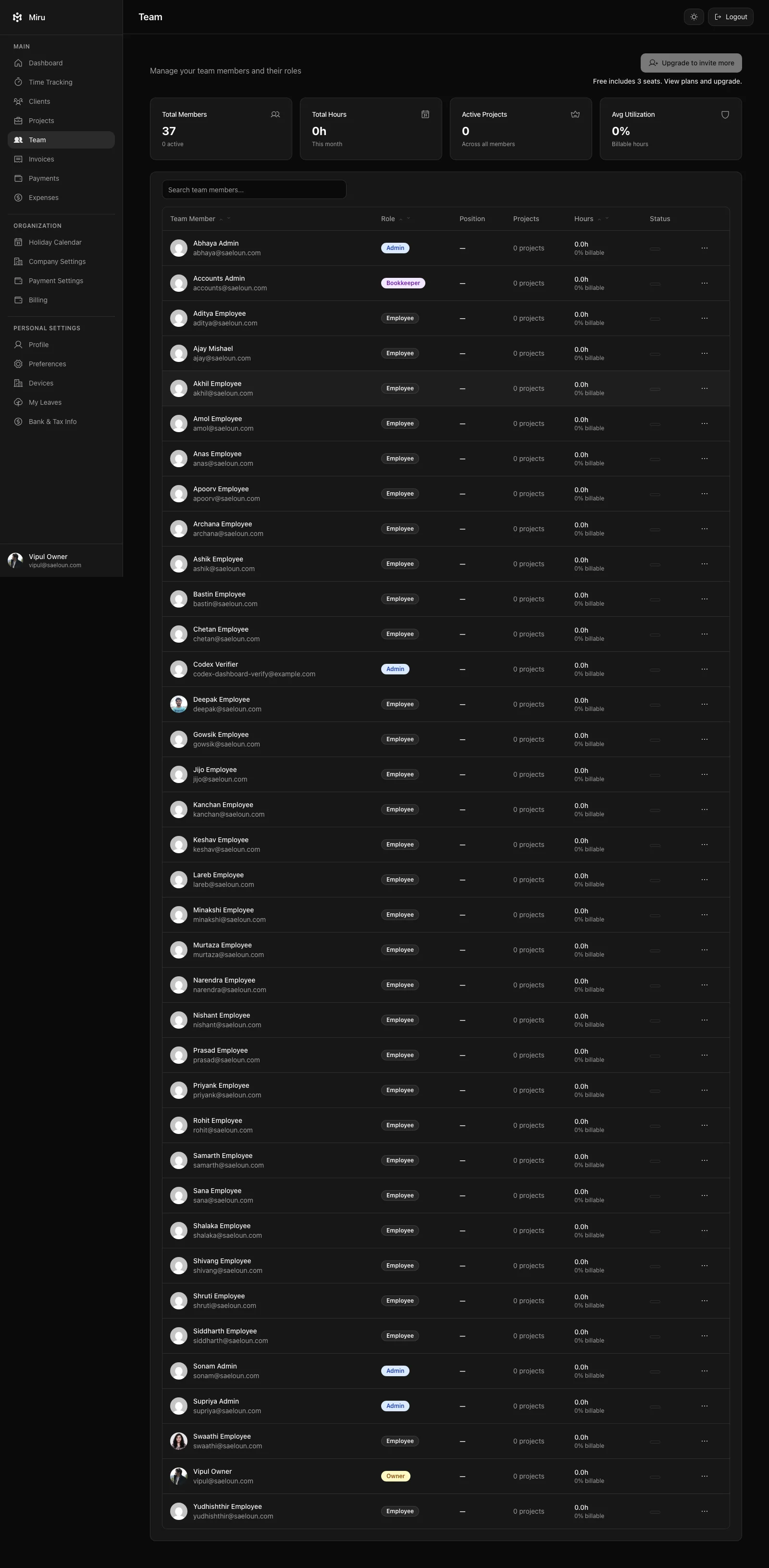
Miru. Obviously. We track every hour, generate every invoice, and manage every expense through our own product. If we wouldn’t use it ourselves, we wouldn’t ship it. Dogfooding isn’t optional — it’s the fastest feedback loop that exists.
What We Don’t Use
No Kubernetes. No Terraform. No Datadog ($70K/year for monitoring? No thanks). No Jira (life is too short). No Confluence (we use GitHub Markdown files). No Notion (we tried it, it became a graveyard of unread documents).
The best tool stack is the smallest one that works. Every tool you add is another login, another bill, another thing that can break, another thing new hires need to learn. We optimize for fewer tools, not more.
Vipul A M
Co-founder at Saeloun. Building Miru. Rails contributor. Shipping from Pune, India.
Read next
How We Track Time with AI Agents and the Miru CLI
A practical guide to automated time tracking for teams using Claude Code, Codex, and other AI coding tools. Real workflows, real scripts, zero browser tabs.
Dark Mode Done Right: Why Most Apps Get It Wrong
CSS invert() is not dark mode. Here's what it actually takes to build a dark theme that doesn't hurt your eyes.
Why We Built the Miru CLI (And Why Every SaaS Should Have One)
Most SaaS tools treat the terminal as an afterthought. We built a full CLI because developers deserve better than a browser tab.
The article is the theory. Miru is the workflow.
If this post is about better billing, cleaner tracking, or fewer tools, Miru is the product version of that argument.